





Gray Stone Powder – your stone-texture filler
Gray Stone Powder is a rock flour, also known as a filler. With it, you can make your own modeling paste and create interesting structures and surfaces. Let your love of experimenting run free.

Make your own modeling paste with acrylic adhesive
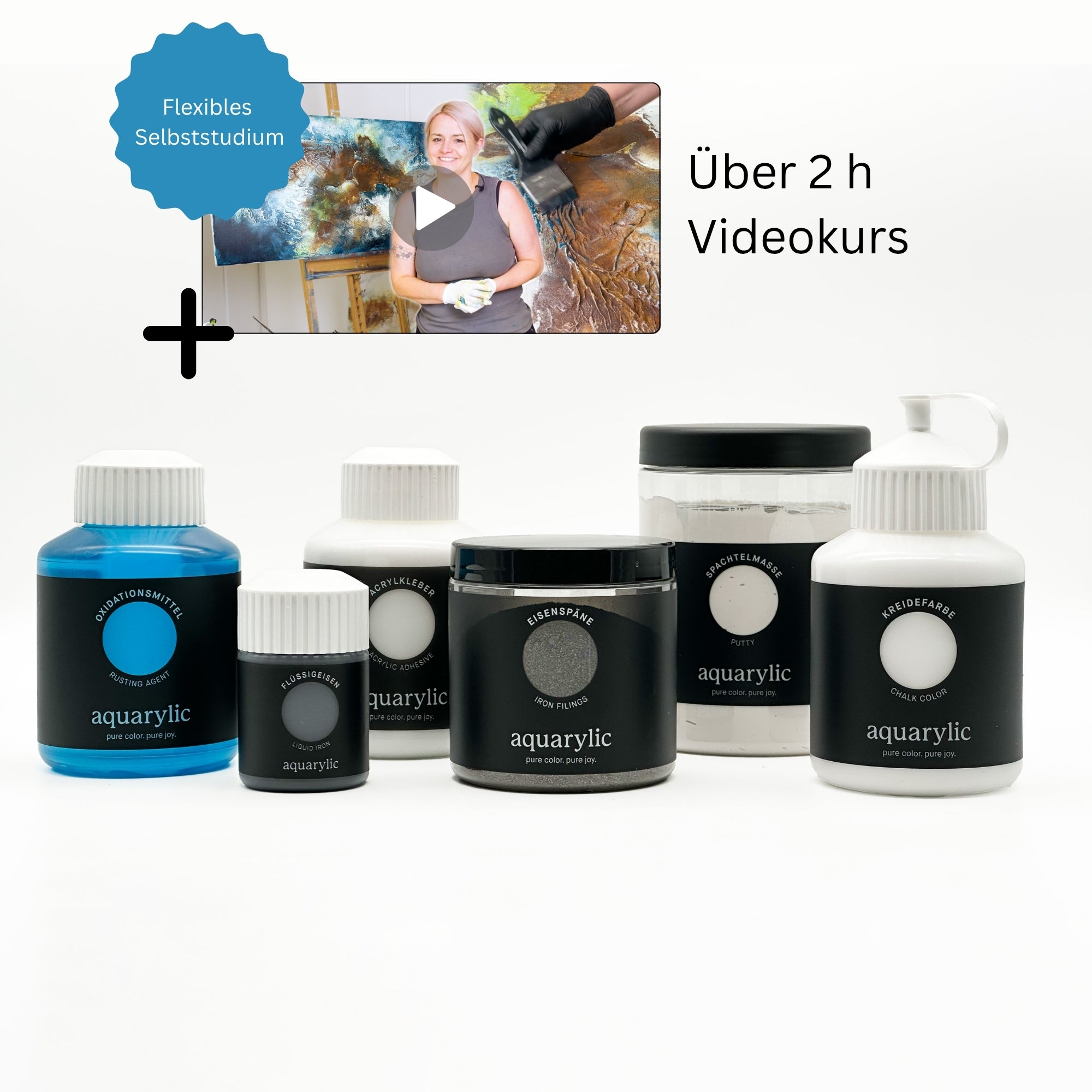
You will need acrylic adhesive and gray stone powder in a ratio of 1 : 3. Our acrylic adhesive has a creamy consistency, exceptionally strong adhesion and is snow-white (but dries transparent). This way, the stone powder keeps its gray color. Other fillers such as ash, sand, etc. can also be used.
Take a tall container with smooth sides. Pour the acrylic adhesive into the container and gradually add the gray stone powder. The mixture is easy to stir with a spatula or a painting knife. Use the spatula to smooth the mixture against the side of the container. Depending on your needs, you can mix the modeling paste a little thinner or thicker. It all depends on how you work it and how you want the modeling paste to show in your artwork.
Homemade modeling paste is often easier to work with and gives a nicer result, because ready-made modeling pastes often have a plastic-like surface and no longer take on paint. They then look like a foreign body in the painting.

Make your own modeling paste with Chalk Paint

Instead of acrylic adhesive, you can also use Chalk Paint White. Its advantage: thanks to the high chalk content of the paint, more cracks form after drying. You can increase the cracking by applying heat. A regular hair dryer works well for this. The thicker you apply the modeling paste (Chalk Paint and gray stone powder), the more cracks appear.
Tip for applying the gray stone powder modeling paste
Apply the modeling paste in different thicknesses to achieve different effects. Contrasts always come across beautifully in a painting. Keep the composition in mind.
Applying gray stone powder loosely
A filler such as gray stone powder always needs a binder. Sprinkle it onto paint that is still wet or onto your damp surface. Spray it with water once more or gently smooth over it with the spatula. Once it has dried, brush off the loose material and keep it for your next work. Everything that stays stuck to the canvas becomes the basis for further techniques. If you like, fix this area with a pastel fixative spray, but this is not strictly necessary. If some gray stone powder still comes loose, it simply mixes with the next layer of paint you apply. This technique is also very popular for painting landscapes.
Oxidizing with the oxidizing agent
Let the filings dry slightly and spray them with the oxidizing agent. Keep in mind that iron only oxidizes while it is wet, so be sure to use plenty of oxidizing agent. The oxidation process can take 1–3 hours and can be repeated as often as needed until you achieve the result you want.
Recipe table: gray stone powder modeling paste
| Binder | Filler | Ratio | Effect |
|---|---|---|---|
| Acrylic adhesive | Gray Stone Powder | 1 : 3 | Creamy, low cracking |
| Chalk Paint White | Gray Stone Powder | 1 : 2 | Forms cracks, matte |
| Chalk Paint + water 1 : 1 | Gray Stone Powder | 1 : 2 | Flowing puddles |
| Acrylic binder | Gray Stone Powder + sand 1 : 1 | 1 : 2 | Grainy, stony |
Tip: Apply the paste in different thicknesses to achieve different effects. Contrasts create depth and a natural interplay of light and shadow.
FAQ
Can I reuse gray stone powder?
Yes – keep any excess grains and use them for your next work.
Does gray stone powder work without a binder?
No – it needs adhesive or Chalk Paint as a binder, otherwise it trickles off.
Conclusion
Gray Stone Powder is your key to authentic stone and concrete looks. Mix, sprinkle & shape – and bring your artworks to life!