





Liquid Iron – Rust in Record Time
aquarylic know‑how
Liquid iron is pure iron in paint form – your fastest route to smooth, velvety rust surfaces. Apply it, spray on a fine mist of oxidizing agent, be amazed. Completely grit‑free – perfect when you are after color rather than texture.

1. What happens chemically?
Once the oxidizing agent has been sprayed on, a slightly acidic film forms. Elemental iron (Fe) oxidizes to Fe2+ and then on to Fe3+. Iron(III) oxide‑hydroxide forms on the surface – the warm rust we love. Every additional spray pass deepens the shade.
2. Materials & tools
- Liquid iron (ready to use)
- Brush or palette knife – depending on the texture you want
- Spray bottle (any fine mist nozzle)
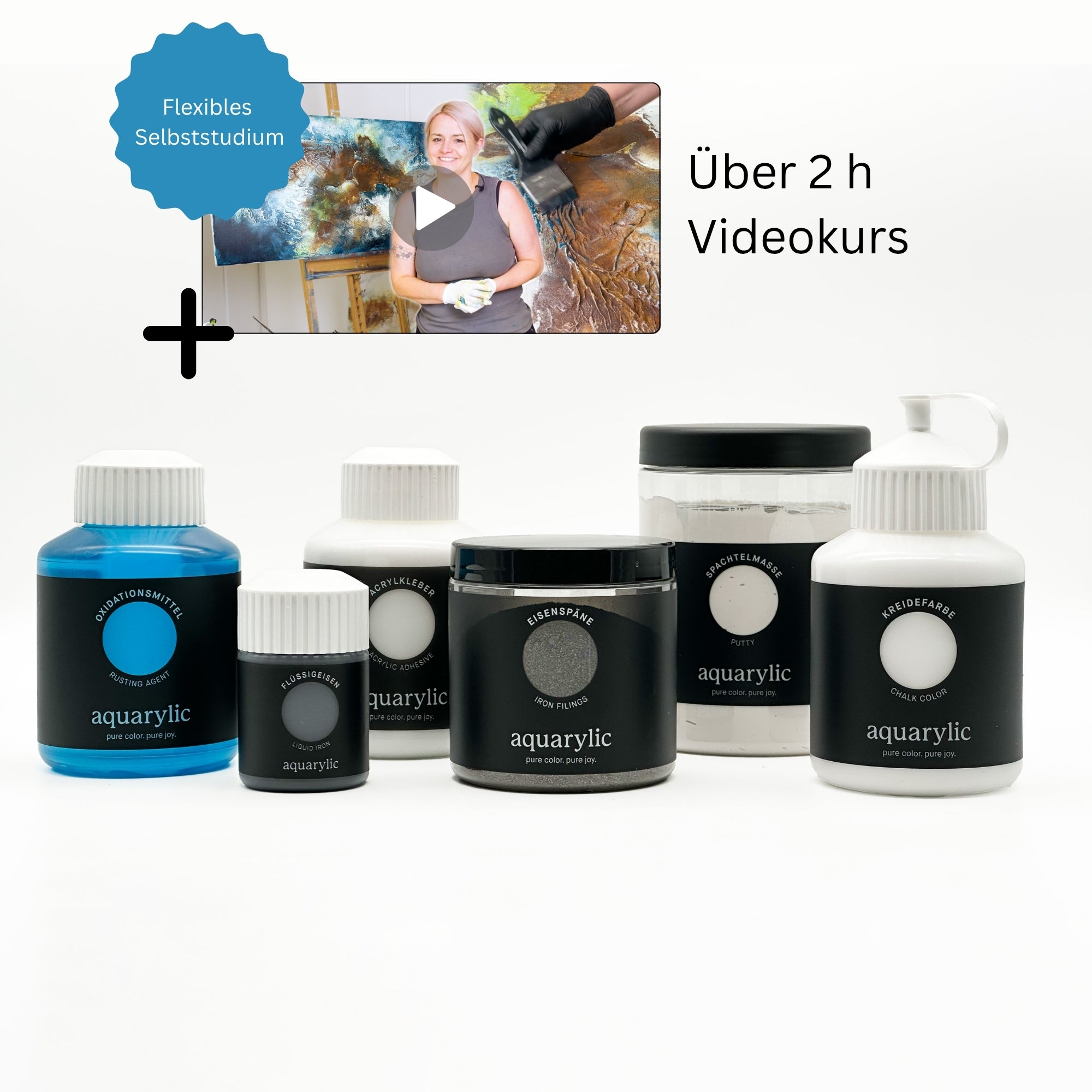
- Oxidizing agent (concentrated)
- Gloves, a protective underlay, and a respirator for large areas if needed
3. Four techniques · four looks
Opaque application
Brush on approx. 0.3 mm – bold, industrial fields of color.
Glazing application
Dilute 1 : 1 with water – translucent veils and subtle gradients.
Pouring & flowing
Pour the mixture in a flowing stream onto a canvas lying flat – spectacular rust runs appear after oxidizing.
Layer & sand
Apply several offset layers and sand lightly in between – steel highlights meet velvety rust.
4. Oxidizing step by step
- Let the layer dry completely (≈ 1 h).
- Apply a fine mist of oxidizing agent – the surface should have an even sheen.
- The first rust tones appear after approx. 90 min. For an intense orange, spray again every 60 min.
- Let the patina keep developing on its own or fix it (see Varnish warning).
5. Rust & color – an exciting interplay
If you paint over a rusted surface with, for example, Chalk Paint White, the rust shows through in an earthy brown. This creates subtle patina effects without any further chemistry.

Project inspiration: rusting sculpture
Material mix: Chalk Paint White • Liquid iron • Iron filings • Acrylic adhesive • Oxidizing agents. Build up layer upon layer, spray repeatedly – and deliberately leave the water runs in place.
Varnish warning: A clear varnish can darken rust tones by up to 15%. Test on a small area first – or deliberately leave the patina untreated. Many artists do not seal real rust at all.
6. FAQ
Can I combine liquid iron with iron filings?
Yes – sprinkle filings into the fresh iron paint. This gives you smooth and richly textured rust zones in a single pass.
How do I stop the rusting process?
Once everything has dried through completely, you can apply varnish. Without a seal, the rust keeps working slowly and may still darken.
7. Want even more rust?
For bold texture & sparkle, read the Iron filings guide. Combine both products and you get two‑tone rust, which no pigment can imitate.